Benefit of Morphine for Acute Coronary Syndrome (ACS)
This clinical guide covers the role, benefits, and significant safety considerations of administering morphine during an acute myocardial infarction. Designed for ACLS providers and emergency clinicians, this article will teach you exactly when morphine is indicated, how to dose it safely, and why recent evidence has made its routine use in ACS increasingly controversial.
ACLS Certification Association videos have been peer-reviewed for medical accuracy by the ACA medical review board.
Article at a Glance
- The Core Benefit: Morphine is a potent analgesic and anxiolytic. By relaxing the patient, it blunts the massive sympathetic nervous system (catecholamine) response, which can reduce the heart’s workload and oxygen demand during a heart attack.
- The Vasodilation Effect: Morphine causes venous pooling (vasodilation), which decreases preload and may help reduce ventricular wall tension, though this effect requires careful blood pressure monitoring.
- Safety Tradeoff: Current guidelines restrict morphine to patients whose chest pain is entirely unresponsive to nitrates. It is no longer an automatic first-line drug for all ACS patients.
- Watch For (Antiplatelet Delay): Recent evidence suggests morphine can significantly delay the gastrointestinal absorption and onset of crucial oral antiplatelet medications (like P2Y12 inhibitors/Plavix), potentially worsening long-term outcomes.
- Morphine is used in ACS for pain unrelieved by NTG.
- Morphine is an opioid analgesic but also promotes relaxation by inhibiting the release of catecholamines.
- Morphine reduces preload and increases coronary perfusion.
- Monitor blood pressure during administration and administer fluids for hypotension.
- The dosage in STEMI is 1–4 mg IV. The provider should monitor for changes in pain levels.
- The reversal agent for morphine is naloxone (Narcan).
Indication of Morphine in ACLS
Morphine is strictly indicated in ACLS for acute coronary syndrome acs cases only when initial doses of nitrates were ineffective in relieving the pain. Let’s say you gave your patient sublingual nitroglycerin, and it didn’t work. The patient still has ischemic chest pain. You tried another nitroglycerin, and it still didn’t work. At this point, morphine is indicated. To understand the complete sequence of how these medications are layered, review our lesson on Chest Pain Suggestive of ACS.
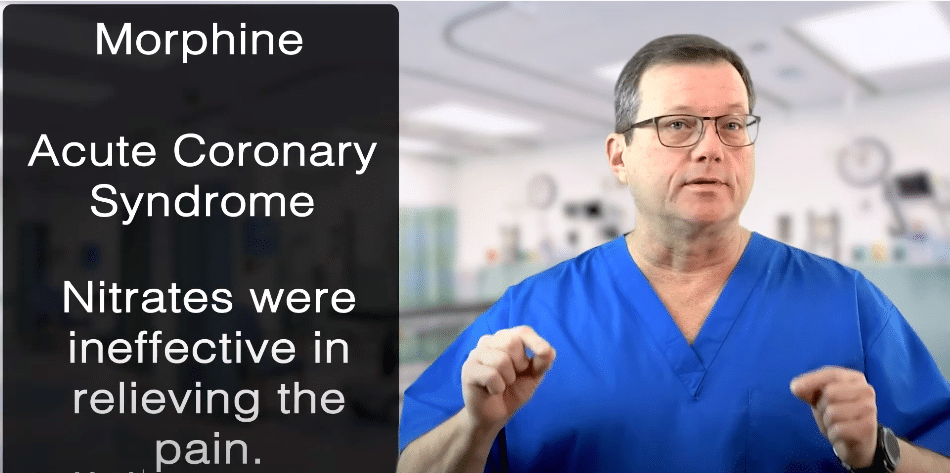
Morphine is indicated in ACLS for acute coronary syndrome where nitrates are ineffective.
What does morphine actually do to the patient? When someone is having an acute myocardial infarction or similar acute coronary event, they are incredibly anxious. Because of this, their body releases a massive surge of catecholamines, such as adrenaline and norepinephrine. These stress hormones make the heart work faster and harder, drastically increasing myocardial oxygen demand. By administering an opioid narcotic like morphine, we relax the patient and blunt that catecholamine surge. Theoretically, this helps the heart work less, aiming to preserve ischemic cardiac tissue.
Read: ACLS Drugs – Lidocaine
The secondary benefit of morphine is its action as a vasodilator, predominantly on the venous side. Morphine causes venous pooling, which reduces preload (the amount of blood coming back to the heart). Reducing this volume can help lower ventricular wall tension, which may help improve coronary perfusion by taking pressure off the inside chambers of the ventricles.
The Controversy: It is critical to note that the routine use of morphine in ACS is increasingly controversial. While it reduces pain, recent evidence suggests that morphine slows gastric emptying, which significantly delays the absorption and onset of crucial oral P2Y12 receptor inhibitors (antiplatelet drugs like clopidogrel or ticagrelor). Because rapid platelet inhibition is vital for patients acute coronary events affect, this delay can lead to worse clinical outcomes.
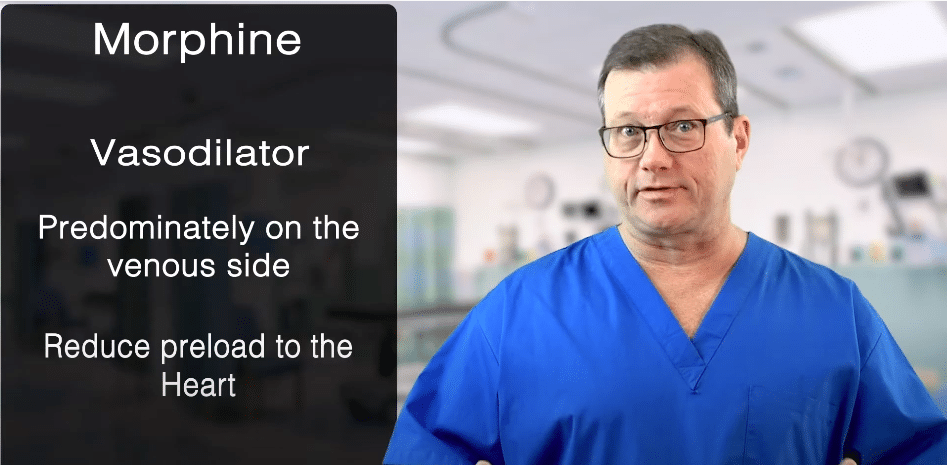
Morphine is also a venous vasodilator, reducing preload.
When to Avoid Morphine
Because of its powerful systemic effects, morphine is not safe for all cardiac patients. Always check for these contraindications:
- Hypotension: Do not administer morphine if the patient is hypotensive. Always monitor their blood pressure closely before and after administration.
- Right Ventricular Infarction: Patients with an inferior or right ventricular MI are heavily dependent on preload. The venous vasodilation caused by morphine can cause profound, lethal hypotension in these patients.
- P2Y12 Administration: As noted above, if rapid absorption of oral antiplatelet medications is the priority of the interventional cardiology team, avoid morphine to prevent delayed gastric absorption.
You may have an instance where your patient is volume depleted (e.g., poor oral intake or sweating). The body compensates by causing vasoconstriction to artificially maintain their blood pressure. If morphine is given in the presence of volume depletion, it breaks that vasoconstriction, and the patient’s blood pressure can tank, plummeting their cardiac output.
When severe hypotension happens following morphine administration, the immediate treatment is to push Intravenous (IV) Fluids to restore the lost preload volume.
Fluid Resuscitation Checklist:
- Administer a 200–500 mL bolus of 0.9% normal saline.
- Reassess blood pressure immediately.
- Auscultate lung sounds continuously. You do not want the fluids to back up and cause pulmonary edema.
Dosing
How much morphine do you give during an ST-elevation myocardial infarction (STEMI)? Because of the risks of hypotension and respiratory depression, morphine is pushed in slow, small increments.
- Dose: 1 to 4 mg.
- Route: Slow IV push.
- Interval: Can be repeated every 5 to 10 minutes if chest pain persists and blood pressure allows.
Reassessment and Documentation: Every time you administer morphine, you must document two things to determine if the drug was actually beneficial or if it is becoming dangerous:
- What was their pain on a 1-to-10 scale before and after the push?
- What was their blood pressure before and after the push? (If systolic BP drops significantly, withhold further doses).
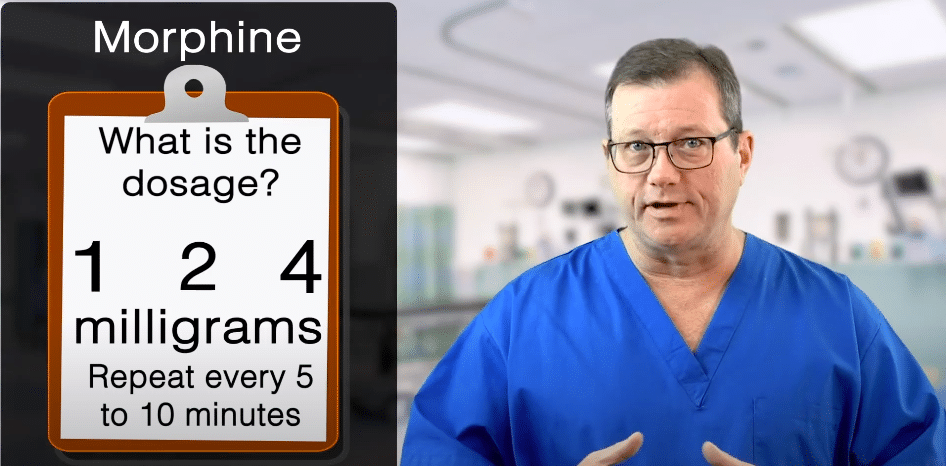
The dosing of morphine for acute coronary syndrome.
Reversal
What if you push the morphine too rapidly, resulting in profound respiratory depression, over-sedation, or a severe hypotensive crash? Morphine is an opioid, meaning it can be immediately reversed if it becomes a threat to the patient’s airway or hemodynamics.
- Antidote: Naloxone (Narcan).
- Dose: 0.4 mg IV (titrated slowly to restore respiratory drive without causing sudden, severe pain rebound).
While severe overdoses are relatively uncommon in ACS management, because the 1-4 mg dosing protocol is on the lower end, providers must always have Naloxone readily available whenever pushing IV narcotics.
Conclusion
The primary benefit of morphine in Acute Coronary Syndrome is its ability to act as a powerful analgesic and anxiolytic. By relaxing the patient, it blunts the dangerous catecholamine surge that drives up myocardial oxygen demand. Secondarily, its venodilator properties help reduce preload. However, because it can mask ischemic symptoms, cause hypotension, and delay the absorption of critical antiplatelet medications required before percutaneous coronary intervention, its use is strictly reserved for patients whose chest pain is entirely refractory to nitrates.
More Free Resources to Keep You at Your Best
Editorial Sources
ACLS Certification Association (ACA) uses only high-quality medical resources and peer-reviewed studies to support the facts within our articles. Explore our editorial process to learn how our content reflects clinical accuracy and the latest best practices in medicine. As an ACA Authorized Training Center, all content is reviewed for medical accuracy by the ACA Medical Review Board.
More to Learn
Master the mean arterial blood pressure (MAP) calculation to assess overall perfusion. Our article helps you understand the significance and accurate measurement of MAP.
Understand the differences between CPR and defibrillation by reading our article. Learn about their critical roles in cardiopulmonary resuscitation and life-saving interventions.