Understanding the Emergency Algorithm for Opioid Overdose
This guide provides a detailed walkthrough of the opioid-associated emergency algorithm for healthcare providers and emergency responders. It outlines the specific steps for managing a patient with a suspected opioid overdose, distinguishing between patients who have a pulse but abnormal breathing and those in full cardiac arrest.
ACLS Certification Association videos have been peer-reviewed for medical accuracy by the ACA medical review board.
Article at a Glance
- Starting Dose: The recommended starting dose for naloxone (Narcan) is typically 2 mg intranasal (IN) or 0.4 mg intramuscular (IM).
- Limitation and Monitoring: Naloxone’s effects can wear off faster than the opioids, meaning the patient may become unresponsive again and require constant monitoring.
- Treatment Pathway: Care depends on whether the patient is in respiratory arrest (requires ventilation and naloxone) or cardiac arrest (requires CPR, AED, and naloxone).
It’s important to understand the opioid-associated emergency algorithm. Providers have had to increasingly rely on it as America’s opioid epidemic has grown. It’s paramount that you know proper treatment protocols.
Opioid-Associated Emergency Algorithm
It’s important to understand the opioid-associated emergency algorithm. Providers have had to increasingly rely on it as America’s opioid epidemic has grown. It’s paramount that you know proper treatment protocols.
While the textual step-by-step guidance below is your primary resource for mastering the protocol, the following visual algorithms, PDF downloads, and video lessons serve as excellent supporting tools to reinforce your understanding.
This lesson reviews the opioid-associated emergency algorithm.

ACLS Opioid Arrest Algorithm
Scene Safety and Evaluating for Signs of Overdose
Remember to first ensure your safety when entering a situation with a potential opioid overdose or cardiac arrest. The scene can present unique environmental hazards.
When evaluating the patient, quickly look for signs suggestive of an opioid overdose. It is important to note that these indicators are not exhaustive, and drug paraphernalia may be completely absent or not definitive for a diagnosis. Evaluate for the following signs:
- Presence of drug paraphernalia (e.g., needles, syringes, pill bottles).
- Pinpoint pupils.
- Respiratory depression or apnea.
- Unresponsiveness or extreme lethargy.
People die from opioid overdose because they stop breathing. Heroin, prescription opioids, and other narcotics are potent respiratory and central nervous system depressants. Providers can strengthen their response readiness through BLS practice tests.
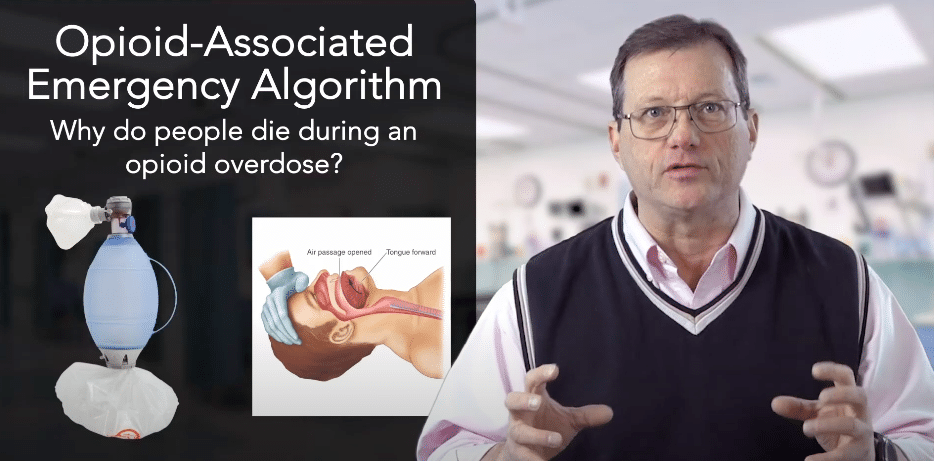
The main cause of death during an opioid overdose is the cessation of breathing.
Read: General Stroke Care
Treatment
A patient who overdoses on opioids is unconscious, and they’ll breathe less often and with less tidal volume. If left untreated, the patient will become severely hypoxic, which can ultimately cause an arrhythmia leading to cardiac arrest. We want to ensure this doesn’t happen by intervening early.
The best initial treatment is to open the airway and provide ventilations with 100% oxygen as you quickly administer the opioid reversal agent. The reversal agent, or opioid antagonist, is called Narcan (naloxone).
While there is no single specific reversal dose (since we rarely know exactly how much of the drug the patient took), dosing is protocol-based and titrated to clinical effect. The recommended starting dose is 2 mg intranasal (IN) or 0.4 mg intramuscular (IM). Intranasal is a popular administration route because it doesn’t involve needles and can be administered quickly.
Limitation and Monitoring: Naloxone’s clinical effect is often shorter than the half-life of many opioids. Therefore, the effect may wear off, and the patient could slip back into respiratory depression. Continuous monitoring and potential repeat dosing are essential.
| Route | Recommended Starting Dose | Notes & Re-dosing |
|---|---|---|
| Intranasal (IN) | 2 mg | Needle-less and rapid. Can be repeated every 2-3 minutes if no response. |
| Intramuscular (IM) | 0.4 mg | Injected into a large muscle. Can be repeated every 2-3 minutes if no response. |
Fentanyl-Involved Overdoses
When potent synthetic opioids like fentanyl are involved, standard initial doses of naloxone may not be sufficient to reverse the respiratory depression. Providers must be prepared to administer multiple, escalating doses of naloxone and closely monitor the patient, as the risk for recurrent apnea and overdose symptoms is significantly higher.
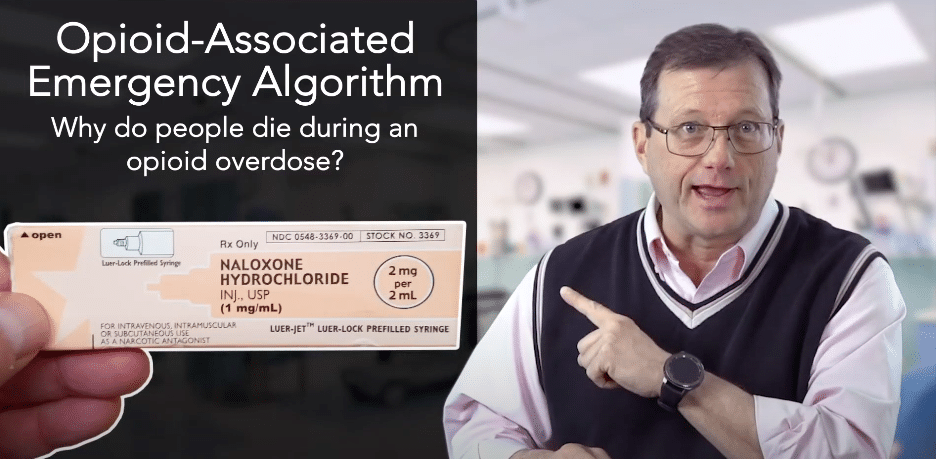
Naloxone (Narcan) is an opioid antagonist, the reversal agent for opioids.
Cardiac Arrest Following an Opioid Overdose
Let’s say that you’ve arrived at the scene and the patient experiencing an opioid overdose is in cardiac arrest. Basically, you’re working a standard cardiac arrest, except with adding Narcan administration into the treatment.
Step 1: Assess and Call for Help
First, establish unresponsiveness. Call 9-1-1 or activate the emergency response system because you’ll need more professional help. You’ll also need an AED and a reversal agent. Take no more than 10 seconds to simultaneously check for a pulse and normal breathing.
Step 2: If NO Pulse, Begin CPR and Defibrillate
If the patient does not have a pulse, begin chest compressions immediately. Operate the same as a standard cardiac arrest, so apply the AED and defibrillate as needed.
Step 3: Administer Naloxone (Narcan)
Administer Narcan as soon as it is available. The dosing is 2 mg intranasal (IN) or 0.4 mg intramuscular (IM). Do not delay high-quality CPR to administer naloxone.
Step 4: Reassess Responsiveness
Again, determine if the patient is responsive. The first dose of Narcan may reverse the overdose. “Responsive” means the patient demonstrates purposeful movement, opens their eyes, or exhibits spontaneous normal breathing. However, the patient may wake up and become unresponsive again. If the response is only partial or temporary, continue to support ventilation and prepare for further treatment.
Step 5: Monitor Closely and Consider Re-Dosing
It’s paramount to constantly monitor the patient. Pay close attention to the pulse oximetry, cardiac monitor, and end-tidal monitoring. You may have to re-administer Narcan (every 2-3 minutes), and some patients may require a Narcan drip when they get to the hospital if they’ve taken large amounts of heroin or potent synthetic opioids.
Step 6: Branching and Ongoing Reassessment
If the patient remains unresponsive and pulseless despite interventions, continue high-quality CPR, follow AED prompts, and proceed with standard Advanced Cardiovascular Life Support (ACLS) protocols. If the patient regains a pulse but remains apneic, switch to rescue breathing and continue monitoring.
Summary
The opioid-associated emergency algorithm branches primarily based on the patient’s pulse status:
- Pulse Present, Abnormal Breathing: Open the patient’s airway, perform rescue breathing (bag-mask ventilation), and immediately administer Narcan.
- No Pulse, No Breathing: Treat them as a standard cardiac arrest with immediate high-quality CPR and AED use, with the addition of Narcan administration as soon as it is available.
In both scenarios, because the half-life of naloxone is often shorter than the half-life of the ingested opioid, the patient must be continually monitored for the recurrence of respiratory depression and unresponsiveness.
More Free Resources to Keep You at Your Best
Editorial Note
ACLS Certification Association (ACA) uses only high-quality medical resources and peer-reviewed studies to support the facts within our articles. Explore our editorial process to learn how our content reflects clinical accuracy and the latest best practices in medicine. As an ACA Authorized Training Center, all content is reviewed for medical accuracy by the ACA Medical Review Board.
More to Learn
This article and video detail Hyperosmolar Hyperglycemic Syndrome. Learn about the management of hyperosmolar hyperglycemic...
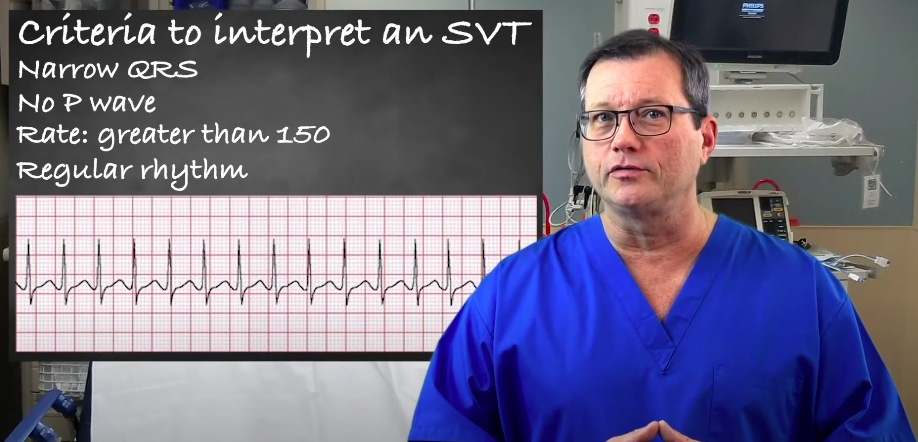
Understand the criteria and interpretation of supraventricular tachycardia (SVT) by reading our article. Learn to accurately identify and evaluate SVT.