Differences Between ST (Sinus Tachycardia) and SVT (Supraventricular Tachycardia)
ACLS Certification Association videos have been peer-reviewed for medical accuracy by the ACA medical review board.
Article at a Glance
- The provider must be able to distinguish between ST and SVT.
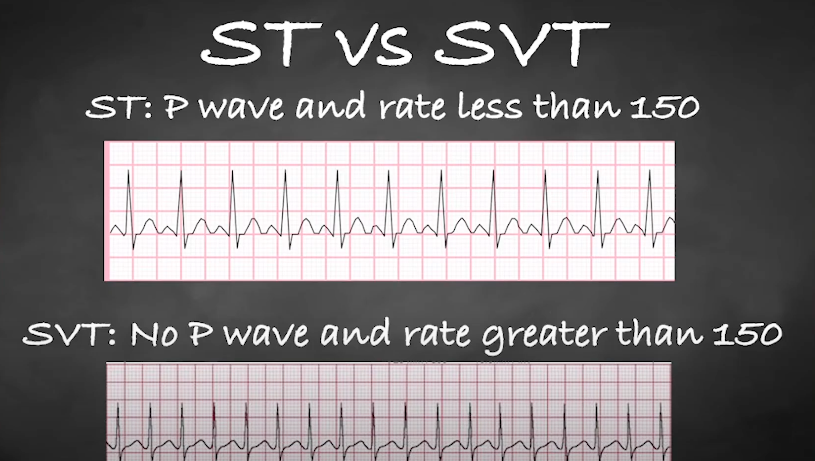
- Sinus tachycardia has a P wave and a rate of < 150 bpm.
- Supraventricular tachycardia has no P waves and a rate > 150 bpm.
When evaluating svt vs sinus tachycardia, there are several key differences to look for during an electrocardiogram (ECG) interpretation. First, similar to normal sinus rhythms, a sinus tachycardia st produces a P wave because it originates from the sinus node. A supraventricular tachycardia svt has no P wave because it usually originates from a reentry circuit somewhere around the atrioventricular (AV) node. In addition to P wave presence and heart rate, clinicians must evaluate several other ECG characteristics when distinguishing sinus tachycardia from supraventricular tachycardia, as outlined in the SVT ECG criteria. Both rhythms typically present as a narrow complex tachycardia with narrow qrs complexes, but rhythm regularity, rate behavior, and wave relationships provide important diagnostic clues. Sinus tachycardia usually demonstrates a regular rhythm with subtle variability related to physiologic demand, such as activity, pain, or fever. In contrast, SVT often shows a very regular rhythm with little to no rate variability once initiated. The QRS complex in both rhythms remains narrow unless there is a preexisting bundle branch block or aberrant conduction. In SVT, atrial activity may be hidden within or immediately after the QRS complex, producing P on T or retrograde P wave patterns that reduce P wave visibility and can make atrial activity difficult to identify. This is uncommon in sinus tachycardia, where P waves typically precede every QRS complex in a consistent manner. Another difference is the heart rate. STs tend to be compensatory or caused by something other than the heart, and the overall rate tends to stay below a rate of 150 bpm. Alternatively, SVTs are usually caused by a re-entry issue somewhere around the AV node. They’re very quick and create overall rates greater than 150 bpm. ST and SVT differ by P wave and heart rate. Sinus tachycardia is most often a normal physiologic response rather than a primary cardiac rhythm disorder. It occurs when the sinus node increases its firing rate in response to increased metabolic demand or stress on the body. Common causes include generalized pain or chest pain, anxiety, fever, dehydration, hypovolemia, hypoxia, anemia, infection, and physical exertion. Medications such as beta agonists and stimulants can also increase sinus node activity. Treating the underlying cause usually results in resolution of sinus tachycardia. Supraventricular tachycardia is most commonly caused by abnormal electrical reentry circuits involving the atria or the atrioventricular node. These circuits allow electrical impulses to loop repeatedly, producing rapid heart rates independent of physiologic demand. SVT episodes may be triggered by stress, caffeine, alcohol, electrolyte imbalances, or underlying structural conduction abnormalities. Unlike sinus tachycardia, SVT is considered a primary rhythm disturbance and often requires targeted rhythm management, such as the administration of adenosine or calcium channel blockers. Another important distinction between sinus tachycardia and supraventricular tachycardia is how the rhythm begins and ends. Sinus tachycardia typically has a gradual onset and gradual resolution, often described as warming up and cooling down as physiologic demands change. In contrast, SVT usually features an abrupt onset and terminates abruptly. Patients often report a clear moment when the rapid heart rate starts and stops. This paroxysmal behavior is a key clinical clue that helps differentiate SVT from sinus tachycardia during rhythm assessment. Read: Criteria for a SVT (supraventricular tachycardia)Differences Between ST and SVT
Related Video – ECG Rhythm Review – Sinus Tachycardia
Related Video – ECG Rhythm Review – Supraventricular Tachycardia (SVT)
What Causes Sinus Tachycardia?
What Causes Supraventricular Tachycardia?
Summary
While they are both classified as narrow complex tachycardias, ST and SVT have their differences. ST has P waves and generally has a heart rate less than 150 bpm. STs are caused by something outside of the heart while SVTs are caused by re-entry issues around the AV node.
More Free Resources to Keep You at Your Best
Editorial Note
ACLS Certification Association (ACA) uses only high-quality medical resources and peer-reviewed studies to support the facts within our articles. Explore our editorial process to learn how our content reflects clinical accuracy and the latest best practices in medicine. As an ACA Authorized Training Center, all content is reviewed for medical accuracy by the ACA Medical Review Board.
More to Learn
Explore third-degree complete heart block and its ECG strip interpretation in our article. Gain insights into diagnosing and understanding this cardiac condition.

Understand the importance of Atropine, a powerful anticholinergic and parasympathetic blocker, in ACLS drug therapy. Read our article to master its use for life-saving interventions.