Difference Between ACLS and BLS
ACLS Certification Association videos have been peer-reviewed for medical accuracy by the ACA medical review board.
Article at a Glance
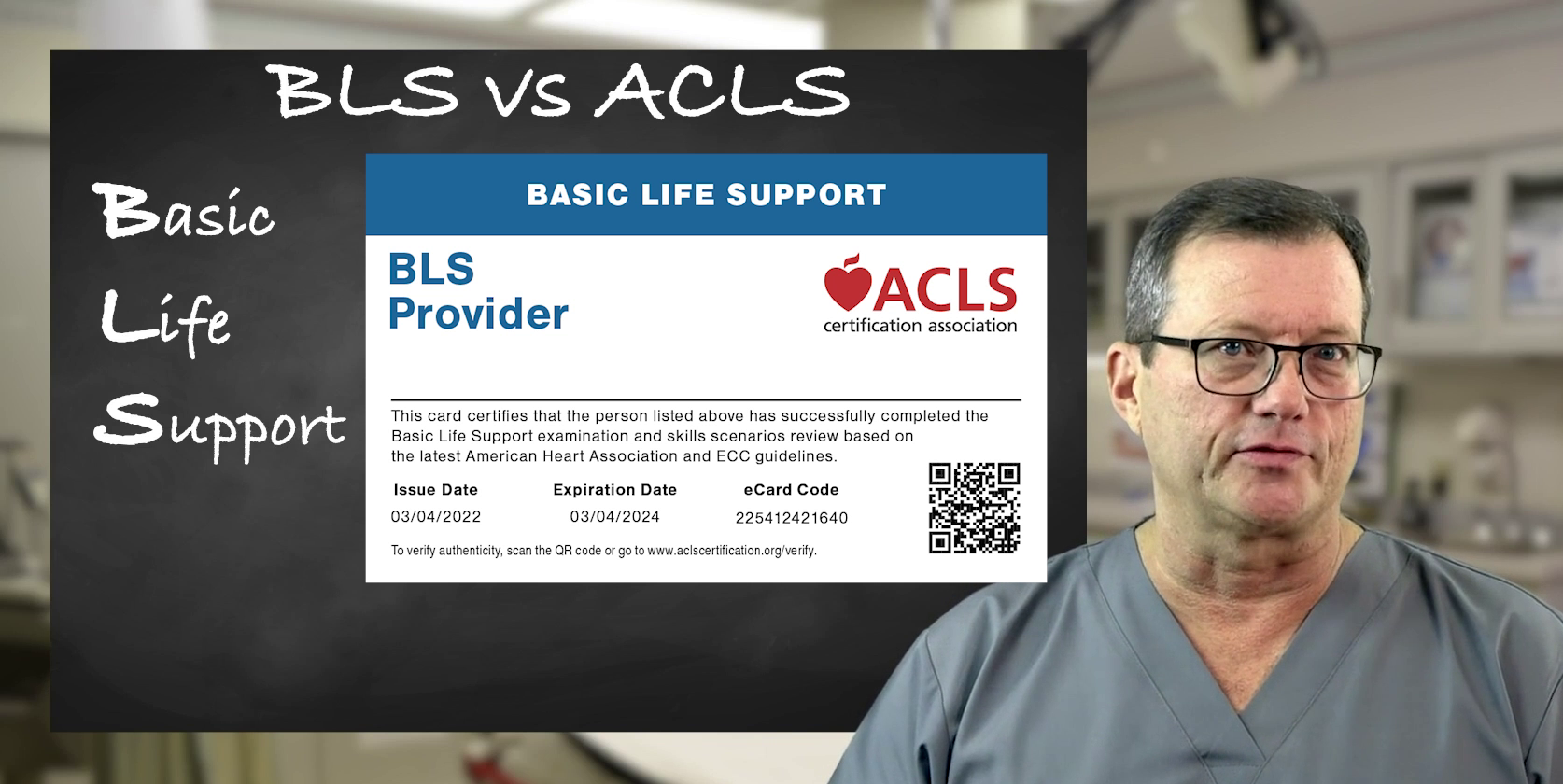
- BLS stands for Basic Life Support, using CPR as the primary treatment.
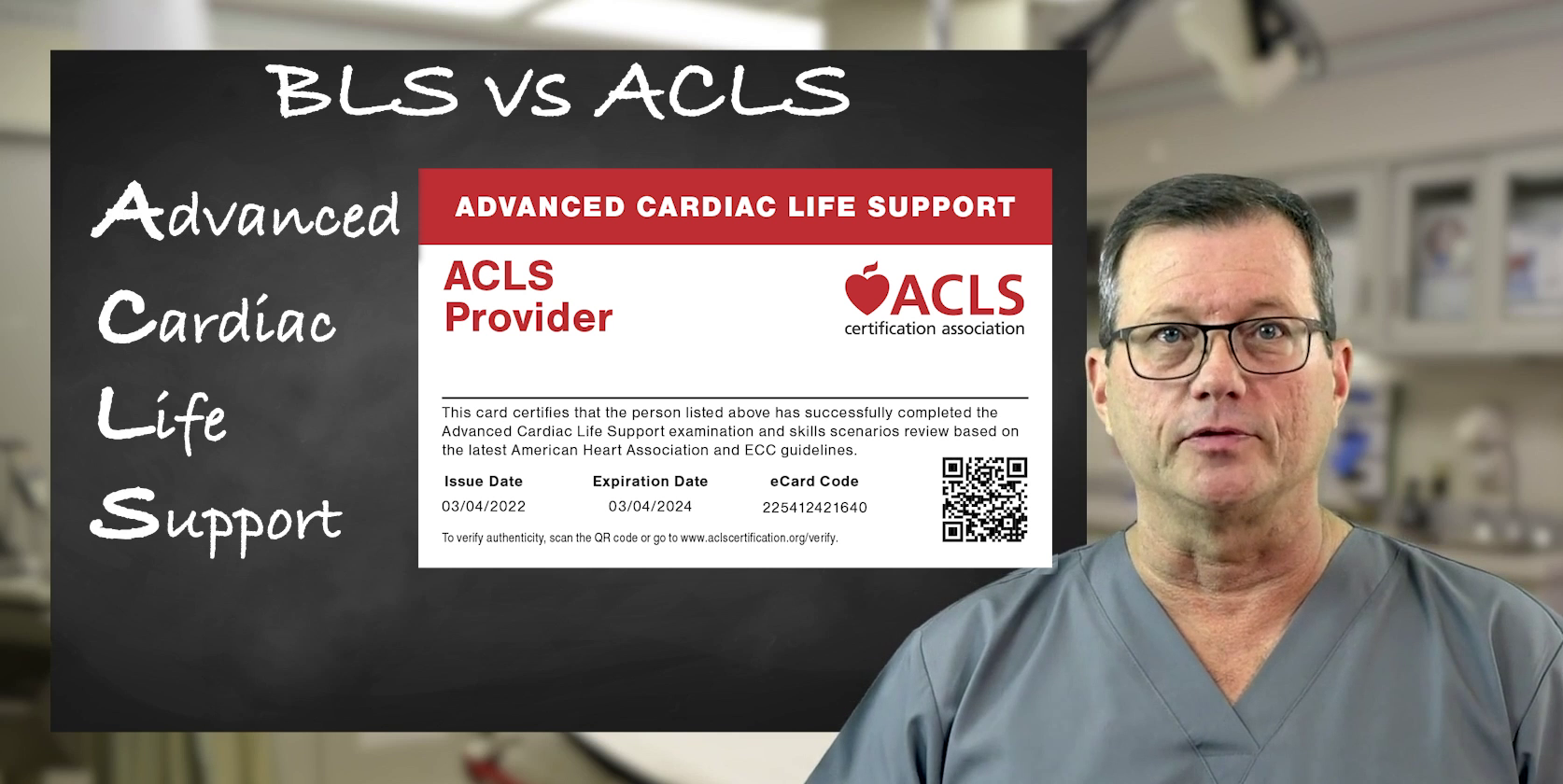
- ACLS stands for Advanced Cardiac Life Support. It is for healthcare providers using advanced techniques and treatments.
- The foundation for ACLS is high-quality BLS.BLS stands for Basic Life Support, using CPR as the primary treatment.
- ACLS stands for Advanced Cardiac Life Support. It is for healthcare providers using advanced techniques and treatments.
- The foundation for ACLS is high-quality BLS.
ACLS and BLS are both lifesaving courses, but they are designed for different roles and environments. In this article, we’ll break down the key differences in scope, target audience, core skills, and the role of medications so you can understand which path fits your goals. By the end, you’ll know what each certification prepares you to do to improve patient outcomes and when one is more appropriate than the other. BLS stands for basic life support. These foundational life-saving techniques and BLS classes vary based on experience levels from a lay person all the way up to a licensed professional. When determining AF, you’ll first notice a lack of a P wave. During atrial fibrillation, the atrial chambers are firing from multiple foci. The firing is quick, random, and chaotic, frequently occurring at a rate of 300–350 bpm with no discernible P-wave on an ECG tracing. BLS stands for Basic Life Support. ACLS stands for advanced cardiovascular life support, and it’s more in depth than BLS. ACLS is designed for healthcare professionals, including licensed providers, paramedics, nurses, physicians, and other health providers. ACLS training covers advanced topics like electrocardiogram (ECG) interpretation, drug administration, advanced airway management, and electrical therapy, all of which can be practiced in an ACLS simulator. But always remember, without adequate BLS, ACLS isn’t going to help. BLS is the first line of defense. Read: Criteria for a SVT (supraventricular tachycardia) ACLS stands for Advanced Cardiac Life Support. The class is more in-depth than a BLS class. If the ventricular rate is less than 100 bpm, it’s a controlled atrial fibrillation. If the ventricular rate is greater than 100 bpm, it’s an uncontrolled atrial fibrillation or atrial fibrillation with rapid ventricular response (RVR).What is the Difference between BLS and ACLS?
Category
BLS (Basic Life Support)
ACLS (Advanced Cardiovascular Life Support)
Level of Care
Basic emergency care and immediate response
Advanced, team-based resuscitation and cardiac emergency management
Primary Goal
Keep oxygen flowing and circulation going until higher-level care arrives
Treat life-threatening cardiac rhythms and stabilize the patient in advanced settings
Target Audience
Healthcare providers and trained responders in many settings
Advanced clinical teams (hospital/EMS roles requiring expanded protocols)
Key Skills
High-quality CPR, AED use, rescue breathing, choking response
Rhythm recognition, airway management, cardioversion/defibrillation coordination, post–cardiac arrest care
Pharmacology
No medication administration focus
Includes medication use as part of algorithms (depending on role and protocol)
Typical Environment
Community, clinics, facilities, and early response before advanced care arrives
In-hospital settings and advanced prehospital teams with protocols and monitoring
Related Video – Basic Life Support for Healthcare Providers
Frequently Asked Questions About ACLS and BLS
When does a BLS provider hand off to ACLS?
A BLS provider hands off to ACLS when advanced medical care is required, such as during sudden cardiac arrest, unstable heart rhythms, or other life-threatening situations where medications and advanced airway management are needed during a cardiac emergency. BLS focuses on immediate life support and stabilization until an ACLS-trained team takes over.
Is BLS a prerequisite for ACLS?
Yes, BLS is generally required before taking an ACLS course, and the BLS algorithm provides the structured foundation for these skills. ACLS builds on the foundational skills taught in BLS, including high-quality CPR with effective chest compressions, the use of an automated external defibrillator (AED), and basic airway management.
Who is required to obtain ACLS certification?
ACLS certification is typically required for healthcare professionals who manage cardiac emergencies, including those working in hospitals, emergency departments, critical care units, and advanced prehospital settings.
Do I need to be a doctor or nurse to get certified?
No. While ACLS is commonly taken by doctors and nurses, other healthcare professionals may also be required or permitted to obtain ACLS certification depending on their role and workplace requirements.
What is the biggest skill difference between a BLS and ACLS provider?
The biggest difference is decision-making at an advanced level. ACLS providers are trained to interpret cardiac rhythms, manage medications, coordinate team-based resuscitation, and adjust treatment based on patient response, while BLS focuses on immediate life-saving actions.
Summary
BLS stands for Basic Life Support and includes basic CPR measures plus more. It’s taught to lay people and medical professionals.
ACLS stands for Advanced Cardiac Life Support and includes more advanced skills such as ECG interpretation. The ACLS class is more in-depth than the BLS class and intended for medical professionals.
Strong proficiency in BLS is essential for success in ACLS, as ACLS training builds directly on the core life-saving skills taught in BLS. A solid understanding of CPR, AED use, and basic airway management provides the foundation needed to perform effectively in advanced cardiac emergencies.
More Free Resources to Keep You at Your Best
Editorial Note
ACLS Certification Association (ACA) uses only high-quality medical resources and peer-reviewed studies to support the facts within our articles. Explore our editorial process to learn how our content reflects clinical accuracy and the latest best practices in medicine. As an ACA Authorized Training Center, all content is reviewed for medical accuracy by the ACA Medical Review Board.
More to Learn
Keep your life-saving skills current with the 2019 AHA focused update on advanced cardiovascular life support. Learn how to use advanced airways, vasopressors, and extracorporeal cardiopulmonary resuscitation during cardiac arrest.

Use the Tachycardia with a Pulse algorithm and detailed article to learn how to appropriately assess and treat this patient.