First-Degree Heart Block
First degree heart block is a conduction delay between the atria and ventricles, most commonly at the AV node. On ECG, it is defined by a prolonged PR interval that stays consistent from beat to beat. This page explains exactly how to measure the PR interval, how to recognize mild versus marked PR prolongation, and what the finding may mean clinically.
ACLS Certification Association videos have been peer-reviewed for medical accuracy by the ACA medical review board.
Article at a Glance
- First-degree heart block is characterized by:
- Regularity: Depends on underlying rhythm
- Rate: Depends on underlying rhythm
- P Wave: Uniform with one for every QRS
- PR Interval: > 0.20 seconds and consistent
- QRS Complex: < 0.12 seconds
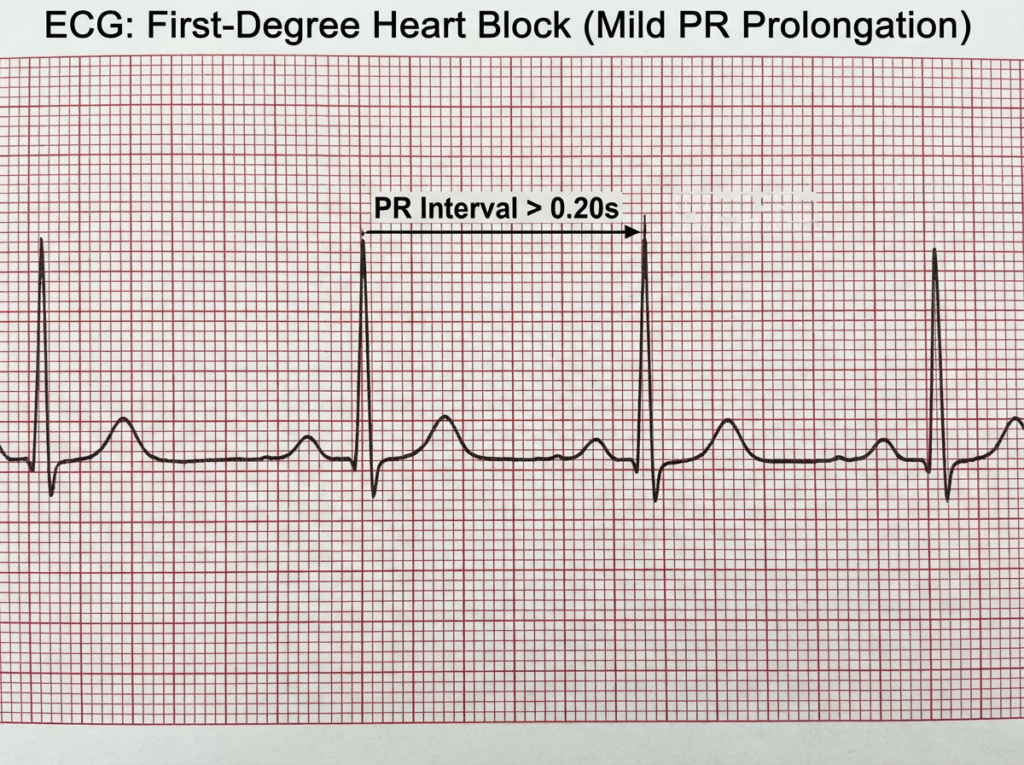
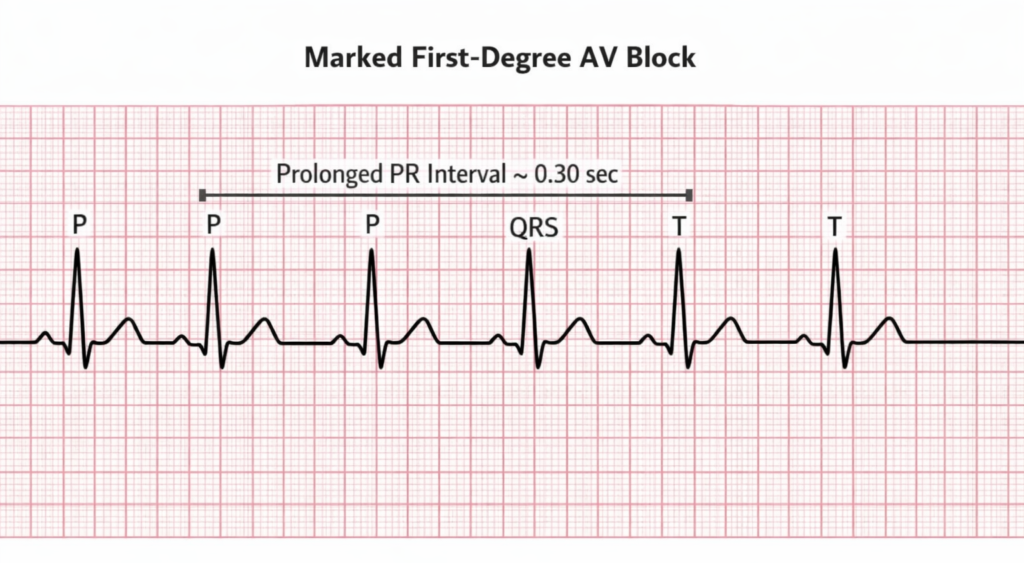
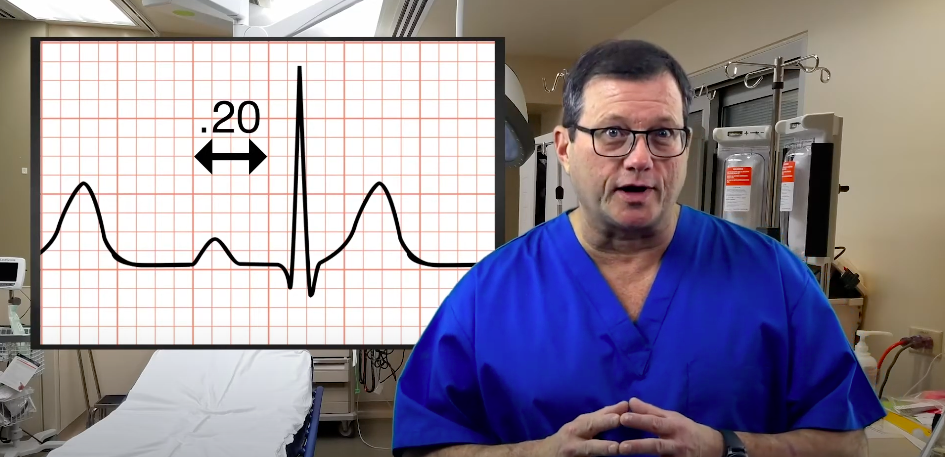
We must examine the relationship between the P wave and QRS complex. A normal PR interval (PRI) is between 0.12 and 0.20 seconds. A first-degree heart block occurs when the PR interval is greater than 0.20 seconds. The second largest box on an electrocardiogram ecg paper measures 0.20 seconds. Locate a P wave that starts right on that box, and if the QRS occurs after the beginning of the next box, there’s a first-degree heart block. To identify first degree heart block, focus on the PR interval, which represents the time it takes for the electrical impulse to travel from atrial depolarization to the beginning of ventricular depolarization. In some cases, irregular atrial activity such as a premature atrial contraction or atrial fibrillation may complicate interpretation. The PR interval is measured from the start of the P wave to the start of the QRS complex. Normal PR interval: 0.12 to 0.20 seconds (120 to 200 ms). Some ECGs show a very prolonged PR interval, sometimes called marked first degree heart block (often PR 0.30 seconds or longer). This can be more clinically significant, especially if the patient is symptomatic or taking AV nodal blocking medications, as progression to higher types of heart block, such as a second or third degree atrioventricular block, may occur. This video walks through a first degree heart block ECG strip and shows how to identify a prolonged PR interval while confirming that every P wave still conducts to a QRS complex. Use it as a visual reference while you practice measuring PR intervals on your own strips. First degree heart block example with a consistently prolonged PR interval. Marked first degree heart block example with a markedly prolonged PR interval. The QRS complex occurs after the beginning of the second box, so we know the PRI is greater than 0.20 seconds. A first-degree heart block is usually benign and asymptomatic. You should still keep an eye on it, as it points to a conduction problem somewhere, potentially around the AV node.Criteria for Determining a First Degree Heart Block
First degree heart block: PR interval greater than 0.20 seconds, with every P wave followed by a QRS complex and a constant PR interval from beat to beat.How to measure the PR interval on ECG paper
Marked first degree heart block
How it differs from other AV blocks
ECG Strip: First Degree Heart Block
What Causes First Degree Heart Block?
As the heart sends electrical signals, first degree heart block occurs when conduction from the atria to the ventricles slows, most often at the AV node. In many people it is an incidental ECG finding, but it can also be associated with medications or underlying heart disease.
Common causes and contributing factors
- Increased vagal tone (often in athletes or during rest and sleep)
- Medications that slow AV nodal conduction, such as beta blockers, non-dihydropyridine calcium channel blockers, digoxin, and some antiarrhythmics
- Ischemia or myocardial infarction, especially involving the inferior wall where AV nodal blood supply may be affected
- Structural or degenerative conduction disease that increases with age
- Myocarditis or inflammatory conditions affecting conduction tissue
- Electrolyte abnormalities and metabolic issues that can slow conduction
If first degree heart block is new or accompanied by symptoms, review medication changes, assess for ischemia when clinically indicated, and consider broader causes based on the clinical context.
Symptoms of First Degree Heart Block
Most patients with first degree heart block have no noticeable heart block symptoms. The rhythm is often discovered incidentally on a screening ECG or during evaluation for an unrelated concern.
When symptoms may occur
Symptoms are more likely if the PR interval is markedly prolonged or if there is an additional conduction abnormality. Some patients may report:
- Fatigue or reduced exercise tolerance
- Lightheadedness, especially with exertion
- Palpitations or an awareness of slow or irregular beats
Symptoms should always be interpreted in context. If a patient is symptomatic, evaluate for other causes and consider whether medications or progression to a higher degree AV block may be contributing.
How is First Degree Heart Block Diagnosed?
The primary diagnostic tool for first degree heart block is the 12 lead ECG. Diagnosis is confirmed when the PR interval is greater than 0.20 seconds and every P wave is followed by a QRS complex.
What clinicians look for on ECG
- Consistent PR prolongation across beats
- One to one AV conduction without dropped QRS complexes
- Any additional findings, such as bundle branch block or ischemic changes, that may suggest broader conduction system disease
Supportive tests when clinically appropriate
Depending on the patient and symptoms, clinicians may also consider:
- Medication review and basic labs for electrolytes and thyroid function
- Cardiac biomarkers and further evaluation if ischemia is suspected
- Ambulatory monitoring if symptoms are intermittent
- Echocardiography if structural heart disease is suspected
Treatment and Management of First Degree Heart Block
In most cases, first degree heart block does not require specific treatment. Management typically focuses on monitoring, addressing reversible contributors, and evaluating symptoms when they are present.
Typical management approach
- Asymptomatic patients: reassurance and routine follow up as clinically indicated
- Medication related PR prolongation: review AV nodal blocking drugs and adjust if needed based on symptoms and provider judgement
- New onset PR prolongation: evaluate for ischemia, myocarditis, electrolyte issues, or conduction disease when appropriate
When closer evaluation may be needed
Consider further evaluation if the patient has symptoms, marked PR prolongation, coexisting bundle branch block, or evidence of progression toward a higher degree av block.
Prognosis and Potential Complications
First degree heart block is often benign, especially when it is isolated and the patient is asymptomatic. However, it can signal slowed conduction in the AV node or broader conduction system disease, so clinical context matters.
Potential considerations over time
- Progression to higher degree AV block in some patients, particularly with underlying conduction disease
- Association with other cardiac conditions depending on the cause, such as ischemic heart disease
- Greater clinical relevance when PR prolongation is marked or when symptoms develop
If the PR interval becomes progressively longer, symptoms develop, or additional conduction abnormalities appear, further clinical evaluation is warranted.
Summary
First degree heart block is identified on ECG when the PR interval is greater than 0.20 seconds while every P wave still conducts to a QRS complex. Accurate diagnosis depends on correct PR measurement and differentiation from higher degree AV blocks that drop beats or show AV dissociation.
Most cases are asymptomatic and do not require treatment. Management focuses on clinical context, reviewing AV nodal blocking medications, and monitoring when the finding is new, marked, or associated with symptoms. Understanding potential causes and prognosis helps clinicians recognize when simple observation is appropriate and when additional evaluation may be needed.
More Free Resources to Keep You at Your Best
Editorial Note
ACLS Certification Association (ACA) uses only high-quality medical resources and peer-reviewed studies to support the facts within our articles. Explore our editorial process to learn how our content reflects clinical accuracy and the latest best practices in medicine. As an ACA Authorized Training Center, all content is reviewed for medical accuracy by the ACA Medical Review Board.
More to Learn
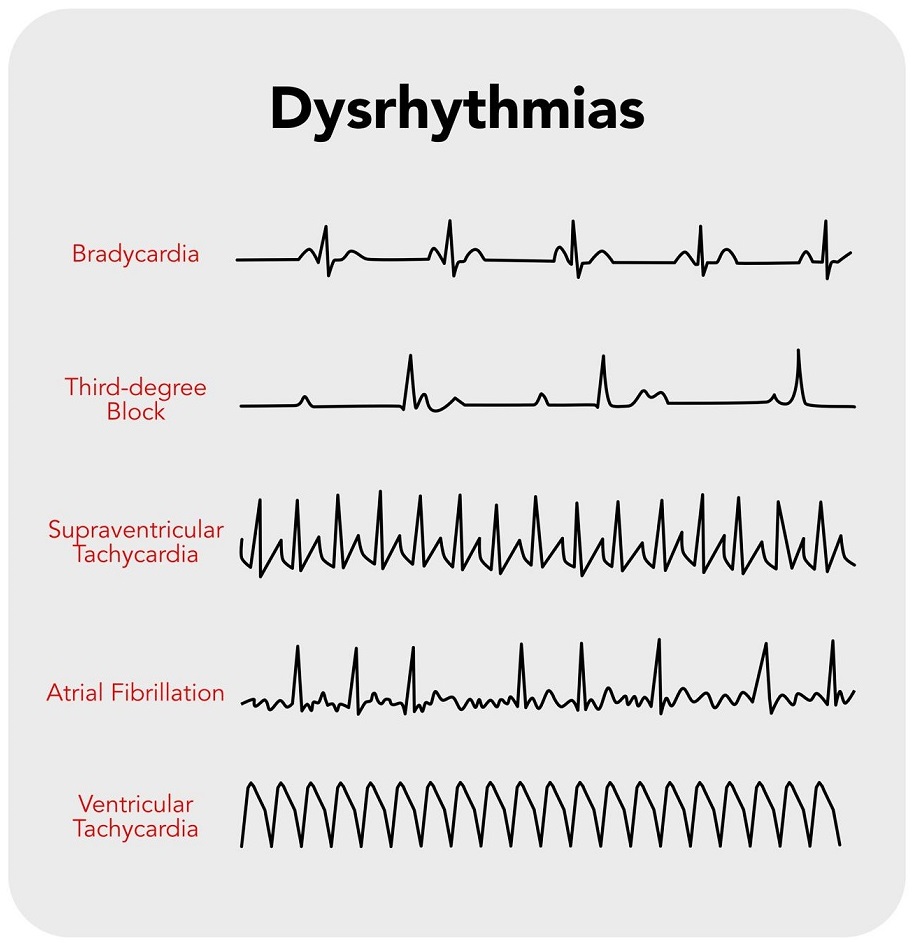
This article and video examine 5 Common Dysrhythmias and Treatments. Explore the assessment and treatments for different...
This article and video review Diabetic Ketoacidosis. Learn the facts and fiction surrounding diabetic ketoacidosis.